The pilot study by journalism student Jaydn James suggests that college students are sleep-deprived and suffer from physical and mental ailments they associate with lack of sleep caused by overexposure to Blue Light.
Blue Light refers to the light emanating from electronic screens that can impact circadian rhythms (sleep patterns). “The circadian rhythm refers to the physical, mental, and behavioral changes that follow a 24-hour sleep and wake cycle that is most sensitive to light,” according to the National Institute of General Medical Sciences.
The health issues related to too much Blue Light exposure include headaches and lack of sleep. Lack of sleep leads to increased cases of distracted driving, depression, anxiety, poor job performance, and for some college students, the potential for poor grades, health experts at UC-Davis explained.
African American college students, particularly journalism majors, spend a large amount of time in front of electronic screens for their studies, reporting and gathering news, and entertainment. One 2018 study revealed that African American college students spent more than 10 hours a day in front of a screen, most of which was geared toward entertainment purposes. The numerous electronic screens that college students have access to leads to increased exposure to Blue Light and its potential hazards.
James came up with the research idea after she experienced headaches related to what she felt were ailments associated with too much Blue Light. She wanted to know if others felt the same way.
James surveyed 70 North Carolina A&T journalism students to learn how too much Blue Light was affecting them.
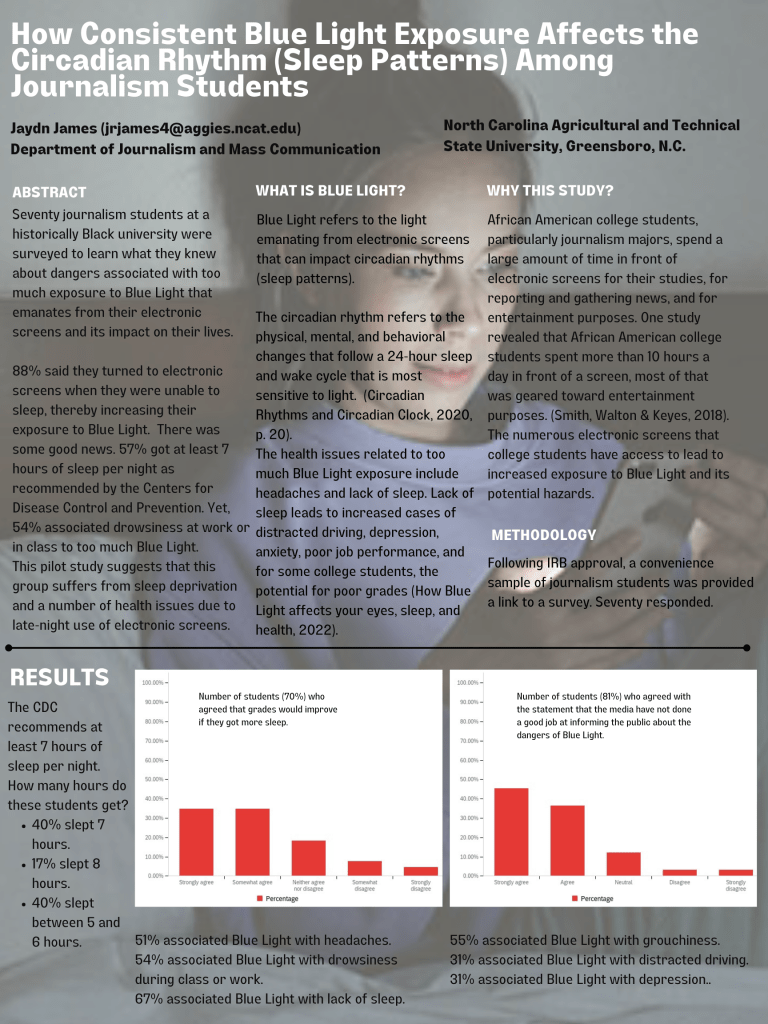
Her study revealed:
- Nearly 90% turned to electronic devices when they could not go to sleep
- 51% of students associated Blue Light with headaches.
- 55% associated Blue Light with grouchiness.
- 54% associated Blue Light with drowsiness during class or work.
- 67% associated Blue Light with lack of sleep.
- 70% said their grades would improve if they got more sleep.
- 81% agreed that the media have not done a good job of informing the public about the dangers of Blue Light.
With only 70 respondents, the results cannot be generalized to a larger population. The results, however, reflect national trends that show college students are sleep-deprived and suffer from ailments associated with exposure to Blue Light.
James will present her study at the Black Doctoral Network Undergraduate Research Poster competition in Atlanta Ga. on Friday, October 20. Her abstract was selected earlier this year among those from across the country. Her advisor is Dr. Kim Smith, an associate professor in the Department of Journalism and Mass Communication at North Carolina A&T State University.
 Stories We Tell
Leave a comment